



Medically Reviewed by Dr. Robert A. Lowe, DDS on August 24, 2026
Most dental implant posts last 25 years or longer, and many function for a patient’s entire lifetime when the surrounding jawbone stays healthy and the implant gets consistent care. The titanium post that replaces the tooth root typically outlasts every other part of the restoration, while the crown attached to it may need replacement after roughly 10 to 15 years of normal biting and chewing wear.
At Charlotte Dental Arts, our team provides dental implants for patients throughout the Charlotte, NC, area, and we know that a confident answer about longevity depends on more than a single statistic. Led by Dr. Edwin Porter, a Fellow in the Academy of General Dentistry and a Diplomate in the International Congress of Oral Implantologists, our team brings over 20 years of combined experience helping patients decide whether an implant, a bridge, or a denture best fits their situation.
How Long Do Dental Implant Posts and Crowns Last?
A dental implant is actually three parts working together: a titanium post that replaces the tooth root, an abutment that connects the post to the visible tooth, and a crown that restores the look and function of the missing tooth. The titanium post, once fused to the jawbone through a process called osseointegration, is designed to function for 25 years or more, and in many patients it lasts a lifetime. The crown on top is the part most likely to need attention, since everyday biting and chewing forces wear it down over roughly 10 to 15 years before it needs replacement.
Most implants placed today use the endosteal design, a screw-shaped titanium post inserted directly into the jawbone. Patients with significant bone loss sometimes need a different approach, and mini dental implants, which are narrower than standard posts, can be an option when there is not enough bone to support a full-size implant. We can help you understand whether you are a candidate for dental implants based on your bone health and overall goals.
What the Research Says
The evidence behind dental implant longevity is compelling. A long-term cohort study published in Clinical Implant Dentistry and Related Research tracked more than 10,000 dental implants over 22 years and found high survival rates among patients who kept up with maintenance. Findings like these confirm that implants are not just a short-term fix but a solution that can hold up for decades in most patients.
That said, the implant itself is only part of the picture. As noted above, the crown that sits on top of the post is subject to everyday biting and chewing forces, so it may need to be replaced at some point, typically after 10 to 15 years. Think of it similarly to how a car engine can outlast its tires: the core structure holds, but the components that take direct wear need occasional attention.
Factors That Influence Implant Longevity
Several variables determine whether an implant lasts 15 years or a lifetime. Understanding these factors can help you make better decisions and take a more active role in protecting your results.
Oral hygiene is the single most controllable factor. Implants cannot develop cavities, but the gum and bone tissue around them can still be affected by bacterial buildup. Peri-implantitis, an inflammatory condition similar to gum disease, is one of the most common reasons implants fail. Patients who brush twice daily, floss consistently, and attend regular dental cleanings and exams significantly reduce this risk.
The following habits and health conditions also play a meaningful role in how long implants last:
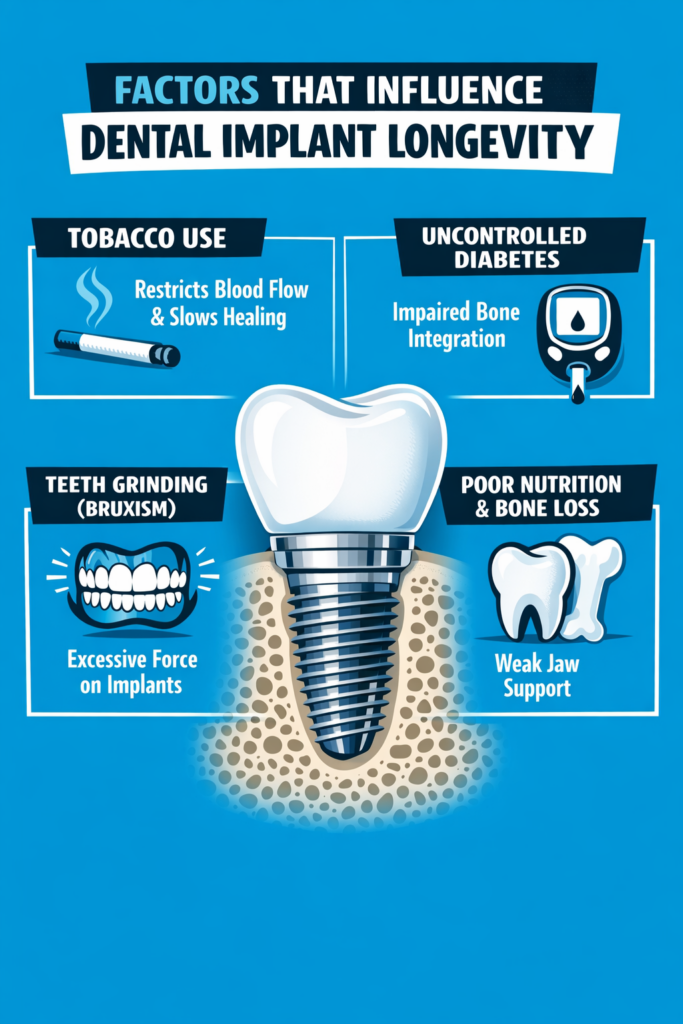
- Tobacco use, which restricts blood flow and slows healing around the implant site
- Uncontrolled diabetes, which can impair osseointegration, the process of bone fusing to the implant
- Teeth grinding, known as bruxism, which places excessive force on the crown and can loosen the implant over time
You are not automatically disqualified from implants if one of these applies to you, but these factors should be addressed and managed before and after placement. Bone quality and quantity in the jaw matter too, since the implant needs a stable foundation to stay in place long term. A customized treatment plan makes a meaningful difference, and we also offer sedation dentistry for patients who feel anxious about the procedure.
Signs Your Dental Implant May Need Attention
Most implants function quietly for years without any noticeable issues, but it helps to know what to watch for. Pain or tenderness around the implant site, swelling or redness in the gums, or a crown that feels loose when you bite down can all signal that something needs a closer look. New difficulty chewing on that side of your mouth is another sign worth mentioning at your next visit.
These symptoms do not always mean the implant has failed. In many cases, catching peri-implantitis or a loosening abutment early allows the issue to be addressed before it affects the implant itself. Patients dealing with missing or failing teeth already understand how quickly a small problem can become a larger one, which is why we recommend reaching out as soon as something feels different rather than waiting for your next scheduled cleaning.
How to Maximize Your Implant’s Lifespan
Getting a dental implant is an investment, and protecting that investment comes down to consistent habits. The osseointegration process, where the jawbone grows around and fuses with the titanium post, takes several months after placement. Following post-procedure instructions during this healing period is especially important.
Once you have healed, routine maintenance for implants is not dramatically different from caring for your natural teeth. Brushing with a soft-bristle toothbrush, using floss or an interdental brush around the implant site, and avoiding chewing on ice or other hard objects all help preserve the crown and the implant beneath it. If you grind your teeth at night, a custom night guard can prevent unnecessary stress on the implant. Understanding the cost of dental implants in Charlotte upfront can also help you plan for any future crown replacement as part of the overall investment.
How Charlotte Dental Arts Supports Long-Lasting Results
Dental implants placed with precision and supported by consistent follow-up care have every reason to last for decades or more. At Charlotte Dental Arts, Dr. Edwin Porter and Dr. Robert Lowe have completed thousands of CEREC same-day restoration cases and complete more than 100 hours of continuing education every year through training programs like the Dawson Academy and the Pankey Institute. That combination of hands-on experience and ongoing education is part of why our practice has been recognized as a Top Dentist in Charlotte Magazine for more than 20 years.
We also make it easier to compare your options. If you are weighing an implant against other solutions, our page on dental implants versus dentures and bridges can help you see how each option holds up over time. Whatever you decide, our goal is the same: a restoration built to last, backed by a team that checks in on it long after the procedure is finished.
Dr. Edwin Porter, DDS, DICOI, FAGD, and Dr. Robert A. Lowe, DDS, FAGD, DABAD, bring decades of combined experience in implant and restorative dentistry to every case at Charlotte Dental Arts. We welcome patients with any dental insurance plan and help you maximize your available benefits, and we also offer flexible financing options, including CareCredit, Cherry Financing, and our Premier Dental Savings Program, so cost is never a barrier to getting the care you need.
Whether you are just beginning to explore implants or are ready to move forward, Dr. Edwin Porter and our team are here to walk you through every step, from your first consultation to years of follow-up care. Contact our office today to schedule your consultation.
Frequently Asked Questions About Dental Implant Longevity
How long do dental implants typically last?
Most dental implant posts last 25 years or longer, and many function for a patient’s entire lifetime when the surrounding bone stays healthy. The crown attached to the post usually needs replacement after about 10 to 15 years of normal biting and chewing wear. Actual results vary based on oral hygiene, bone health, and lifestyle habits like smoking or teeth grinding.
Does the crown wear out faster than the implant itself?
Yes, in most cases. The titanium post fuses with the jawbone and is built to hold up for decades, but the crown sits above the gum line and absorbs the everyday forces of biting and chewing. Most crowns last 10 to 15 years before they need replacement, and the cost of a new crown is typically much lower than the cost of a full implant.
What are common signs that a dental implant may be failing?
Pain or tenderness around the implant site, swelling or redness in the gums, a crown that feels loose, or new difficulty chewing on that side of your mouth are all worth mentioning to your dentist. Catching these signs early often allows peri-implantitis or a loosening abutment to be treated before it affects the implant itself.
Can smoking or diabetes shorten the life of a dental implant?
Both can play a role. Smoking restricts blood flow and can slow healing around the implant site, while uncontrolled diabetes can interfere with osseointegration, the process of bone fusing to the implant. Neither condition automatically disqualifies someone from getting an implant, but they should be managed carefully before and after placement.
How often should I see the dentist after getting a dental implant?
Most patients benefit from the same schedule recommended for natural teeth, which is a cleaning and exam about every six months. Patients with a history of gum disease or peri-implantitis may need more frequent visits so any early changes around the implant can be caught and addressed quickly.
Is bone loss a concern before getting a dental implant?
Yes, it can be. An implant needs enough bone quality and quantity in the jaw to stay stable long term, and bone loss can accelerate the longer a tooth stays missing. Patients with significant bone loss may still qualify for an implant with additional planning, such as a bone graft or a different implant design.
About the Author
Charlotte Dental Arts
Dr. Robert A. Lowe is a Diplomate of the American Board of Aesthetic Dentistry and holds Fellowships with the Academy of General Dentistry, the International College of Dentists, and the Academy of Dentistry International, among others. He earned his DDS from the School of Dentistry at the University of North Carolina at Chapel Hill and serves as an Associate Professor at the Medical University of South Carolina, and he brings his background in esthetic and restorative dentistry to patients at Charlotte Dental Arts.