


Medically Reviewed by Dr. Edwin Porter, DDS, DICOI, FAGD on August 26, 2026
Most people don’t realize that when their dentist refers them to an oral surgeon for an implant, two separate providers are making decisions about the same tooth, without always being in the same room. The surgeon places the implant with one set of goals in mind; the general dentist restores it with another. It works often enough, but it leaves a critical question unanswered: who planned the final result before the first incision was ever made?
At Charlotte Dental Arts, that question has a clear answer. Dr. Edwin Porter, a Diplomate in Implantology from the International Congress of Oral Implantologists and a Fellow in the Academy of General Dentistry, built the practice’s dental implant process around a single principle: the restoration drives every decision. Rather than placing an implant and figuring out the crown later, Dr. Porter designs the final outcome first and works backward from there, all under one roof.
Why Most General Dentists Refer Out
Implant dentistry sits at the intersection of two very different disciplines: surgery and restorative care. Placing an implant requires surgical training, while restoring it requires a different skill set focused on the crown, bite, and aesthetics. Most general dentists are trained in one but not both, which is why referrals to periodontists or oral surgeons are so common.
There is nothing wrong with that model, and specialists are excellent at what they do. The challenge is coordination. When the surgical provider and the restorative provider operate separately, the final crown position is sometimes an afterthought rather than the starting point. Dr. Porter observed this dynamic early in his career and decided to take a different path.
The Training Required to Keep Everything In-House
Offering the full spectrum of implant care is not a decision a dentist can make overnight. Dr. Porter pursued residencies in implant placement and surgery specifically so he could control the outcome from start to finish. His path to the ICOI Diplomate designation required completing over 120 implant cases demonstrating advanced restorative procedures, 250 continuing education hours, published case documentation, and a rigorous examination from the Advanced Credentialing Committee.
That level of preparation translates directly into the approach taken at Charlotte Dental Arts. Our restorative dentistry foundation informs every surgical decision, so the implant is always positioned to support the final crown rather than the other way around.
How Digital Planning Makes It Possible
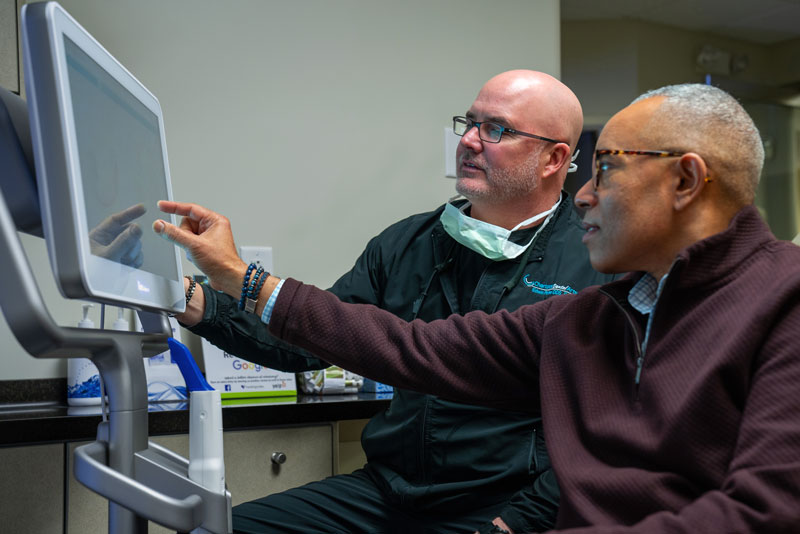
The technology behind this approach is what separates restorative-first implant planning from traditional methods. Dr. Porter uses CT scans and intraoral digital scans, then merges those images to create a complete three-dimensional picture of the patient’s anatomy. The final crown is designed virtually before any surgery begins.
From there, the implant position is mapped precisely on a computer screen. A surgical guide is printed that physically directs where the implant goes during placement, based entirely on where the restoration needs to be. Research published in the National Institutes of Health’s open-access journal found that prosthetically driven digital workflows produce stable peri-implant bone levels and high patient satisfaction at one-year follow-up, underscoring why pre-planning the restoration before surgery matters. You can learn more about how we use this technology on our digital implant planning page.
What This Means for Patients in Charlotte
For patients, this approach means fewer appointments, less back-and-forth between providers, and greater predictability from the very first consultation. In many cases, extraction and implant placement can be performed in the same oral surgery visit, which most patients genuinely appreciate, since nobody wants more surgical visits than necessary.
It also means your treatment plan is coordinated by one clinician who understands both the surgical and restorative dimensions of your case. The implant is placed not just where the bone allows, but exactly where the final crown needs it to be.
Schedule a Consultation at Charlotte Dental Arts
Dr. Edwin Porter has been recognized as a Top Dentist in Charlotte Magazine for over 20 years. His training spans the Pankey Institute, Dawson Academy, and Spear Education, with additional mentorship through CEREC Doctors and the Institute of Mega Implant. He has completed over 6,000 CEREC same-day restoration cases and serves as a visiting faculty member training other dentists nationally in digital dentistry.
If you have been told you need an implant and want to know what a fully coordinated, restorative-first approach looks like, we encourage you to contact our office and schedule a consultation. From digital planning to final restoration, everything happens here, designed around the outcome your smile deserves.
Frequently Asked Questions About Coordinated Implant Care
Why do most dentists refer patients out for dental implants?
Implant dentistry combines surgical skill with restorative expertise, and most general dentists are trained primarily in one discipline. Referring the surgical portion to a periodontist or oral surgeon is a common and reasonable model, though it requires close coordination between providers.
What does a restorative-first implant approach mean?
A restorative-first approach means the final crown is designed before the implant is surgically placed, so the implant position is chosen specifically to support that planned restoration rather than being decided independently of it.
Can extraction and implant placement happen in the same visit?
In many cases, yes. When candidacy allows, extraction and implant placement can be combined into a single oral surgery visit, reducing the total number of surgical appointments needed.
What is digital implant planning?
Digital implant planning uses CT scans and digital impressions merged into a three-dimensional model of your jaw, allowing the dentist to design the final restoration and map the exact implant position before surgery, then guide placement with a printed surgical guide.
About the Author
Dr. Edwin Porter, DDS, DICOI, FAGD
Founder, Charlotte Dental Arts
Dr. Porter has over 20 years of experience in cosmetic and restorative dentistry and is a Fellow of the Academy of General Dentistry. He has been recognized as one of Charlotte Magazine’s “Top Dentists” for more than two decades and focuses his practice on smile makeovers, implant dentistry, and same-day restorative care.