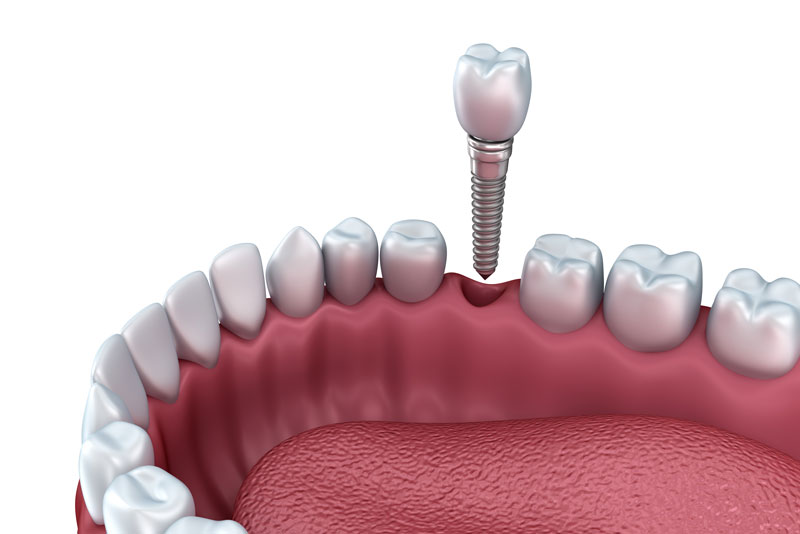
When a tooth is lost, the decision about how to replace it is more consequential than many patients realize. The right choice affects how you eat, how your jawbone ages, and how your surrounding teeth behave for years to come. Dental implants have become the standard of care for tooth replacement because they are the only option that addresses the root of the problem, literally, by replacing the tooth root rather than just the visible crown.
At Charlotte Dental Arts, dental implants in Charlotte, NC are placed and restored entirely in-house by Dr. Edwin Porter, a Diplomate of the International Congress of Oral Implantologists (DICOI). This credential is the highest implant-specific certification available to a general dentist and requires a minimum of 120 documented implant cases, 250 continuing education hours, and a rigorous examination. Most general dentists refer implant cases out to a separate oral surgeon. Dr. Porter performs every phase of implant treatment at Charlotte Dental Arts.
The Problem With Not Replacing a Missing Tooth
Many patients assume that a missing tooth, especially one in the back of the mouth, is primarily a cosmetic issue. It is not. When a tooth root is lost, the jawbone beneath it loses the stimulation it needs to maintain its density. Bone resorption begins within the first year after tooth loss and continues progressively over time. The result is a narrowing and shrinking of the jaw that changes facial structure, affects the fit of surrounding teeth, and makes future implant placement more complex.
Adjacent teeth also tend to drift into the gap over time, creating spacing issues, bite problems, and increased risk of decay in areas that become harder to clean. What starts as a single missing tooth can escalate into a broader restorative problem if left unaddressed.
Why Implants Outperform the Alternatives
Implants vs. Dental Bridges
A traditional dental bridge replaces a missing tooth by anchoring a false tooth between two crowns placed on the adjacent teeth. This requires grinding down healthy teeth on either side of the gap — teeth that would not otherwise need restorative work. Implants do not involve adjacent teeth at all. The implant post is placed directly in the jawbone, functioning as an independent tooth root that supports its own crown. This protects neighboring teeth and preserves their structure long term.
Implants vs. Dentures
Conventional dentures sit on the gums and are held in place by suction or adhesive. They do not replace tooth roots, which means bone resorption continues beneath them. Over time, the jawbone changes shape, causing dentures to lose their fit and requiring periodic adjustments or replacement. Dentures also restore only a fraction of natural biting force — studies indicate conventional dentures restore roughly 20% of natural function, while implant-supported restorations restore upward of 98%. For patients who want to eat without limitation and without the daily management that removable prosthetics require, implants offer a permanent, fixed alternative.
Longevity
Dental implants are designed to last a lifetime with proper care. The implant post itself, once fully integrated with the jawbone, is permanent. The crown placed on top of the implant may require replacement after 15 to 20 years depending on wear, but the underlying structure remains intact. Dentures typically require replacement every 7 to 10 years. Bridges often need replacement at 10 to 15 years and can compromise the teeth they are anchored to over time.
Who Is a Candidate for Dental Implants?
Most healthy adults who are missing one or more teeth are candidates for implants. The key requirements are adequate jawbone volume to support the implant post, healthy gum tissue, and no active infection in the mouth. For patients who have experienced bone loss following tooth loss, bone grafting can rebuild lost volume before implant placement. This is evaluated at the consultation using 3D CBCT imaging, which shows bone density and volume in three dimensions and allows Dr. Porter to plan implant placement with precision before surgery begins.
Patients with controlled diabetes, certain medical conditions, or a history of smoking can often still receive implants, though success rates are slightly lower and candidacy is assessed individually. Uncontrolled systemic disease and active smoking are the most common limiting factors.
The Implant Process at Charlotte Dental Arts
The dental implant process at Charlotte Dental Arts begins with a free consultation that includes imaging, a clinical evaluation, and a written treatment plan with itemized pricing before any commitment is made. Surgical placement is performed in-office by Dr. Porter under local anesthesia or sedation, depending on the patient’s preference. After a healing period of three to six months during which the implant integrates with the jawbone, the final crown is placed using same-day CEREC technology, allowing the restoration to be designed, milled, and placed in a single appointment.
Charlotte Dental Arts: In-House Implant Care From Start to Finish
Dr. Edwin Porter has earned the “Top Dentist in Charlotte” award for over 20 years and has completed more than 6,000 CEREC same-day restoration cases. His DICOI Diplomate credential places him among a small group of general dentists in North Carolina performing implant surgery at a specialist level. Financing is available through CareCredit, Cherry, and Proceed Finance, and the practice files insurance claims on behalf of PPO patients. Schedule your free implant consultation today and leave with a clear plan, honest pricing, and no obligation to proceed on the same day.