

The transformation from mastering a revolutionary technology to teaching others how to use it marks one of dentistry’s most significant professional journeys. For practitioners who witnessed the birth of digital dentistry in research labs decades ago and stayed the course through its evolution, this path has been defined by constant learning, adaptation, and the commitment to elevate the entire field through education.
At Charlotte Dental Arts, Dr. Edwin Porter embodies this evolution, having been involved with digital dentistry since 1988 when he worked on research projects related to the very first version of CAD/CAM dental work. As a Fellow in the Academy of General Dentistry and former visiting faculty at CEREC Doctors, his journey from student to educator illustrates how the most skilled practitioners never stop learning, even as they teach others.
The Long Road From Research to Clinical Practice
Digital dentistry’s timeline is far longer than many realize. Dr. Porter’s involvement started in 1988, but the path to clinical application took considerable time.
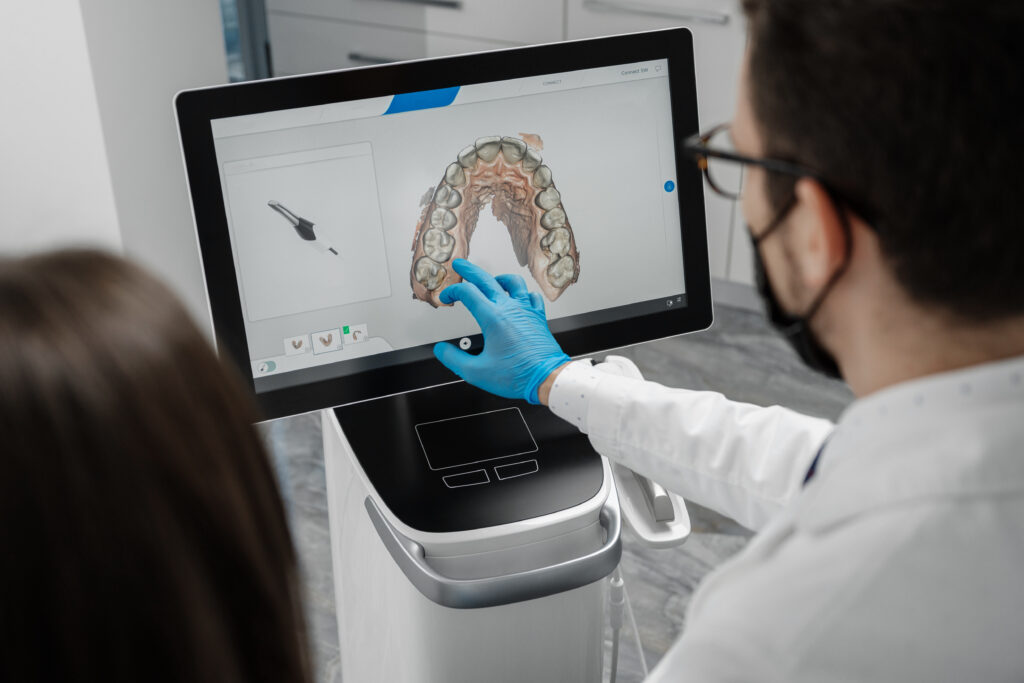
“It took quite a while for the technology to get to a point where I felt comfortable using it in private practice, and that was probably 15 years ago,” he explains. This lengthy development period meant that early adopters weren’t just learning established procedures but rather participating in the technology’s refinement. Today, Dr. Porter has completed more than 6,000 CEREC same-day restoration cases — a volume that places him among the most experienced digital dentistry practitioners in the Southeast.
From Private Practice to the Teaching Podium
The shift from practitioner to educator represents a pivotal evolution in a dentist’s career, one that enriches both teaching and clinical practice.
The Natural Progression to Education
For many experienced practitioners, the shift from learning to teaching happens organically. Dr. Porter’s educational journey began during his final two years of dental school when he was asked to teach classes for students a few years behind him. After entering private practice, opportunities emerged to train doctors first within North Carolina, then across state lines, eventually leading to work at a teaching facility in Arizona.
Financial constraints, limited faculty expertise, and curriculum time remain persistent barriers to digital dentistry integration in dental education broadly, making experienced practitioners like Dr. Porter invaluable resources for advancing the field at the clinical level.
The Student Mindset Never Ends
Despite decades of experience, the most effective educators maintain their identity as perpetual students. “To be clear, you’re always a student,” Dr. Porter emphasizes. “Since 1990 in dentistry, I have remained a student myself, especially the way things evolve and change — dental materials and dental technology are changing constantly. You have to be a student or you’re just not up to speed.”
Teaching Changes How You Practice
The reciprocal relationship between teaching and practicing creates a powerful feedback loop that enhances both educational and clinical outcomes. “The more you teach, the better you get,” Dr. Porter notes. “The more that I’m exposed to other practices and other practitioners, it’s enlightening to say the least.” This exposure to diverse practices, varying skill levels, and different approaches to digital dentistry enriched his own understanding and refined his techniques.
One of the most important lessons Dr. Porter emphasizes in his teaching addresses a common misconception about technology. “I say this to my staff all the time: just because you have all this technology doesn’t mean you’re better than other people. You have to really work hard at what you do and your craft, and you have to be better than you were as an analog dentist.” He continues: “When you’re using digital technology, it’s so detailed, and there are so many things you have to make sure you’re perfect on. There’s really not a margin of error that you probably could have gotten away with in analog dentistry.”
The Most Rewarding Aspect of Sharing Knowledge
When asked about the most fulfilling part of teaching other practitioners, Dr. Porter’s answer is direct: “Just helping them advance their craft.” He stresses the importance of proper education, noting that practitioners who learn digital dentistry the right way “can do amazing things, but if you don’t, you’re not going to be any better at all. You just have fancy tools that may make you think you’re better.”
The Challenge of Slow Adoption
Despite the clear advantages of digital dentistry, its integration into mainstream practice has progressed more slowly than many pioneers anticipated. Dr. Porter estimates that even in Charlotte, roughly 80% of dentists are still performing analog impressions rather than using digital workflows. This limited adoption persists globally, with estimates suggesting only 15 to 18% of dentists worldwide have fully embraced digital dentistry. The gap partly stems from inconsistent integration into dental school curricula.
Material Science Drives Innovation
When discussing the most consequential advances in digital dentistry, Dr. Porter points to materials science as the primary driver. “The advancement in materials and what we’re able to produce chairside that we couldn’t do even five years ago is phenomenal,” he explains. Scanner technology has also advanced considerably, with Dr. Porter having worked through multiple iterations of CEREC technology in his own practice.
For Charlotte Dental Arts patients, this means access to same-day crowns, bridges, and inlays fabricated from high-strength zirconia and lithium disilicate in a single appointment — materials that were unavailable or impractical in chairside digital workflows as recently as ten years ago.
What This Means for Charlotte Dental Arts Patients
The fact that Dr. Porter has trained other dentists in digital dentistry is not incidental. It reflects a depth of understanding that goes beyond simply using the technology — it reflects having thought carefully enough about it to explain it to others at a high level. Patients at Charlotte Dental Arts receive care from a practitioner who has tested the limits of the technology, identified where it requires precision and care, and refined his technique accordingly over thousands of cases.
Dr. Porter has been recognized as a “Top Dentist in Charlotte” for over 20 years. Charlotte Dental Arts offers cosmetic, implant, and family dentistry in south Charlotte with same-day digital restoration technology in-house. Contact our office today to schedule an appointment.