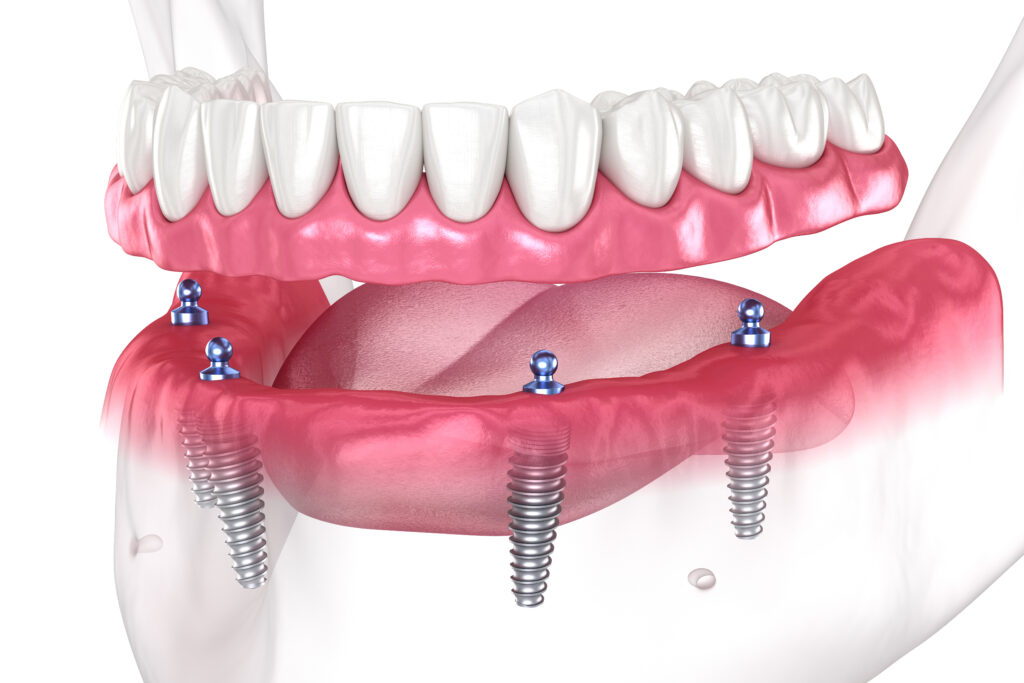



All-on-4 dental implants in Charlotte, NC are placed in a single, carefully planned surgical appointment: four titanium implants are positioned at precise angles in the jawbone, a temporary full-arch prosthesis is attached the same day, and a final zirconia restoration follows after a few months of healing. The process relies on advanced 3D imaging, a custom surgical guide, and same-day temporary teeth, so patients leave with a functional new smile before the permanent bridge is ever placed.
At Charlotte Dental Arts, All-on-4 dental implants in Charlotte, NC are performed from start to finish by Dr. Edwin Porter, a general dentist who holds a Diplomate credential from the International Congress of Oral Implantologists (DICOI). Because every phase of care, from consultation through final restoration, happens under one roof, patients avoid the back-and-forth coordination that often comes with treatment split across multiple specialists.
How All-on-4 Dental Implants Are Placed
The All-on-4 procedure follows a consistent sequence of steps, though every treatment plan is customized to the patient’s anatomy, bone volume, and smile goals. Here is what that sequence typically looks like from the first consultation through the final restoration.
Consultation and 3D Treatment Planning
Treatment begins with a comprehensive consultation that includes a Cone Beam Computed Tomography (CBCT) scan and digital impressions of the mouth. This imaging allows Dr. Porter to evaluate jawbone density and volume, identify nerve and sinus locations, and map the exact position and angle for each of the four implants before any surgery takes place. Reviewing dental implant candidacy at this stage helps confirm whether a patient’s bone structure and oral health support the All-on-4 protocol, or whether additional preparation may be needed first. This is also when smile shape, tooth color, and other aesthetic preferences are discussed, since the design of the final prosthesis begins here rather than after surgery.
The Surgical Appointment
On the day of surgery, sedation dentistry is typically used to help patients stay comfortable and relaxed throughout the procedure. Two implants are placed vertically toward the front of the jaw, where bone density tends to be strongest, and two are angled toward the back to maximize contact with the available bone. This angled placement is the defining feature of the All-on-4 technique, and in many cases it can reduce or eliminate the need for a separate bone grafting procedure that traditional implant placement might otherwise require.
A custom surgical guide, generated from the pre-operative CBCT scan, helps position each implant with precision. For patients who qualify, a temporary acrylic prosthesis is attached to the implants during the same appointment, so a functional, natural-looking set of teeth is in place before the visit ends.
Healing and Osseointegration
Over the following three to six months, the jawbone gradually fuses with the titanium implants through a process called osseointegration. Patients wear the temporary prosthesis during this period, which allows for normal speaking and a soft-food diet while the implants stabilize. Following the recommended diet and attending scheduled follow-up visits during this phase can support a smoother healing process. Mild soreness or swelling in the days after surgery is common and can typically be managed with over-the-counter pain medication as directed by the dental team.
Placement of the Final Prosthesis
Once osseointegration is confirmed, the temporary prosthesis is replaced with the final restoration. At Charlotte Dental Arts, final All-on-4 prostheses are milled from high-strength zirconia and custom-shaded, shaped, and sized to complement each patient’s facial features. Unlike a removable denture, the finished prosthesis is fixed in place and functions similarly to natural teeth for everyday eating, speaking, and smiling.
All-on-4 Versus Traditional Dentures and Bridges
Patients weighing their full-arch options often want to know how All-on-4 compares with removable dentures or an implant-supported bridge that requires more implants per arch. Traditional dentures rest on the gums and can shift while eating or speaking, while All-on-4 restorations anchor the entire arch to four fixed implants for added stability and no nightly removal. A closer look at how dental implants compare with dentures and bridges can help clarify which approach may fit a particular case, since factors like bone volume, budget, and the number of remaining teeth all play a role in that decision.
How Successful Are All-on-4 Dental Implants?
Long-term data on the All-on-4 protocol is encouraging. A 2021 retrospective cohort study published in the National Library of Medicine’s PubMed Central database followed 126 patients who received 544 implants for All-on-4 restorations and reported an implant survival rate of 98.2 percent. Individual outcomes can vary based on bone quality, oral hygiene, and overall health, but this data reflects why All-on-4 has become a widely used option for full-arch tooth replacement.
Who Is a Good Candidate for All-on-4 Dental Implants?
All-on-4 is designed for patients missing all or most of the teeth in one or both arches, including those whose remaining teeth cannot be meaningfully saved. Because the angled implant design maximizes use of the available bone, many patients who have experienced some bone loss following long-term tooth loss can still be candidates. Adequate healing capacity and manageable gum health are also part of the evaluation. Candidacy is confirmed at the consultation using CBCT imaging alongside a clinical exam, and the cost of All-on-4 treatment in Charlotte is typically discussed at that same visit, once a treatment plan has been finalized.
How Charlotte Dental Arts Supports Your All-on-4 Treatment
Choosing where to have All-on-4 dental implants placed matters as much as the technique itself. At Charlotte Dental Arts, Dr. Edwin Porter brings more than 25 years of experience along with a DICOI Diplomate credential, one of the more advanced implant-specific distinctions a general dentist can hold. Every phase of treatment, from the initial CBCT scan through surgical placement and final zirconia restoration, is handled in-house, so patients are not shuffled between separate surgical and restorative offices for the same procedure.
Our team also walks patients through sedation options, financing, and what to expect at each stage before treatment begins, so there are no surprises on surgery day. New patients are welcome, and for anyone still deciding between All-on-4 and other tooth replacement options, our team can review imaging, bone volume, and goals together to help identify the path that may fit best.
See Us Now So We Can Treat You With All-on-4 Dental Implants
Dr. Porter has completed more than 6,000 CEREC same-day restorations and has been recognized as a Top Dentist in Charlotte by Charlotte Magazine for more than 20 consecutive years. His advanced training, including coursework through the Dawson Academy and the Pankey Institute, supports a level of surgical and restorative planning that many full-arch patients look for when choosing a provider for a permanent procedure.
If you are ready to find out whether All-on-4 dental implants may be right for you, our team can walk you through imaging, candidacy, and a personalized treatment timeline at a single consultation visit. Get in contact with Dr. Edwin Porter and our exceptional team at our Charlotte Dental Arts office to schedule an appointment today.
Frequently Asked Questions About All-on-4 Dental Implant Placement
How Long Does the All-on-4 Procedure Take?
The surgical appointment for one arch typically takes a few hours, and most patients leave the same day with a temporary set of teeth already in place. The full treatment timeline is longer, since the jawbone needs three to six months to heal and fuse with the implants before the final zirconia prosthesis is attached. Your dental team can give you a more specific timeline once your CBCT scan and treatment plan are complete.
Will I Need Bone Grafting Before All-on-4 Treatment?
Many patients do not need bone grafting for All-on-4 because the angled placement of the posterior implants makes use of denser bone that is often still available even after some bone loss. Patients with more significant bone loss may still benefit from grafting or another preparatory step. Your candidacy, including whether grafting could help, is assessed with CBCT imaging and a clinical exam during your consultation.
What Is Recovery Like After All-on-4 Surgery?
Most patients experience some mild swelling or soreness in the days following surgery, which can typically be managed with over-the-counter pain medication as directed. A soft-food diet is recommended while the temporary prosthesis is in place and the implants begin to integrate with the jawbone. Many patients return to normal daily activities within a few days, though full osseointegration takes several months.
How Successful Are All-on-4 Dental Implants Long Term?
A 2021 study following 126 patients who received All-on-4 restorations reported an implant survival rate of 98.2 percent. Outcomes can vary based on factors like bone quality, oral hygiene, and overall health, but published data supports All-on-4 as a well-established option for full-arch tooth replacement when candidacy is properly assessed beforehand.
How Is All-on-4 Different From Traditional Dentures?
Traditional dentures rest on the gums and can shift while eating or speaking, while All-on-4 restorations are anchored to four implants fixed in the jawbone. This generally means more stability, fewer dietary restrictions, and no adhesives or nightly removal. All-on-4 also uses fewer implants than some traditional full-arch implant approaches, which can make treatment more accessible for patients with certain bone conditions.